
Best Sealants for Metal Gutters: A Buyer's Guide
by Editorial Team
Table of Contents
- Why Sealant Choice Matters for Metal Gutters
- Best Sealant for Metal Gutters: Key Selection Criteria
- How to Seal Metal Gutter Joints: Preparation and Application
- Gutter Sealant Cure Time and Weather Resistance
- Silicone Gutter Sealant vs. Tripolymer: Which Performs Better
- Common Mistakes That Lead to Gutter Sealant Failure
- When to Repair vs. Replace a Gutter
- Frequently Asked Questions
Last Updated: October 12, 2026
Why Sealant Choice Matters for Metal Gutters
Metal gutters face constant temperature swings, standing water, and UV rays. A weak sealant fails within months; the right one lasts years. The difference is chemistry and substrate compatibility.
Most contractors grab whatever's on the hardware store shelf. It works on wood trim or vinyl siding, but on metal it's a gamble.
This guide covers what separates a sealant that holds from one that fails on metal gutters: chemistry, application conditions, and real-world performance.
Best Sealant for Metal Gutters: Key Selection Criteria
Choosing the best sealant for metal gutters comes down to four factors: adhesion, weather resistance, application flexibility, and cure behavior. First, know which metal you're sealing. Aluminum, galvanized steel, copper, and painted finishes each behave differently, and a product that grips one can stain, lift, or slide off another.
Match the Sealant to the Metal
Aluminum. The most common residential gutter metal. Bare aluminum forms a near-instant oxide layer that repels many adhesives, and mill finish often carries drawing oil.
Galvanized steel. The zinc coating is the point and the problem: it reacts with some sealant chemistries, and chalky or white-rusted zinc kills adhesion.
Copper. The premium substrate and the least forgiving. It patinas, moves more than steel, and stains easily; many standard sealants leave discoloration no cleaning removes.
Painted finishes. Factory-finished and field-painted gutters are slick, and paint varies from hard acrylic to soft alkyd.
Adhesion to Metal Surfaces
Adhesion is where most sealants fall short on metal. The surface is slick, sometimes oily from manufacturing or oxidation.
Look for products engineered for metal substrates. Tripolymer chemistry outperforms silicone on metal because it grips oily surfaces without primer, while silicone caulks need clean, dry surfaces to bond at all.
The best sealants for metal gutters bond to damp surfaces, not just dry ones. Gutters collect moisture, so you'll often seal seams after rain, with dew present, or in high humidity.
Weather and UV Resistance
Metal gutters live outside, facing direct sun, freeze-thaw cycles, and standing water. A sealant that hardens in sun or turns brittle in cold will crack and fail.
Flexibility matters as much as strength. Metal expands and contracts with temperature, and copper moves more than steel.
UV resistance prevents degradation: exposed sealants go chalky, lose adhesion, and let water in.
Mildew and mold resistance is a bonus. Gutters trap moisture and organic debris, so a sealant that resists microbial growth stays cleaner and lasts longer.
Application in Real Conditions
Theory and practice diverge. A sealant might work perfectly in a lab but fail in the field because application conditions were poor.
The best sealants for metal gutters apply across a wide temperature range without perfect surface conditions. Some demand 50°F minimums; others work colder.
Non-stringing application matters for speed and cleanup. A sealant that pulls away in thin filaments is messy and wastes material; a clean, non-stringing formula goes down faster and looks professional.
Self-leveling or semi-self-leveling products flow into seams and settle flat without tooling, saving time on long gutter runs.
Cure Behavior and Paintability
Cure behavior decides how long you have to work the bead and how soon the joint can take water.
Paintability is the quiet selection criterion. On finished gutters, an unpaintable bead is a permanent visible stripe. If color match matters, confirm the sealant accepts paint after cure and whether it needs primer. Most silicones reject paint, one more reason they underperform on finished metal.
How to Seal Metal Gutter Joints: Preparation and Application
The sealant is only half the equation. Preparation and technique determine whether it bonds properly and lasts.
Surface Preparation Steps
Clean the joint thoroughly with a wire brush to remove rust, loose paint, oxidation, and debris, then blow out dust and moisture with compressed air.
For painted metal, roughen the surface with fine sandpaper or a scotch pad. Smooth paint is slick; a light scuff gives the sealant something to grip.
Remove failed or contaminated old sealant with a utility knife or removal tool. New sealant won't adhere over leftover caulk.
Wipe the joint with a clean cloth. A wet surface is fine for tripolymer products; silicone needs it completely dry.
Application Technique
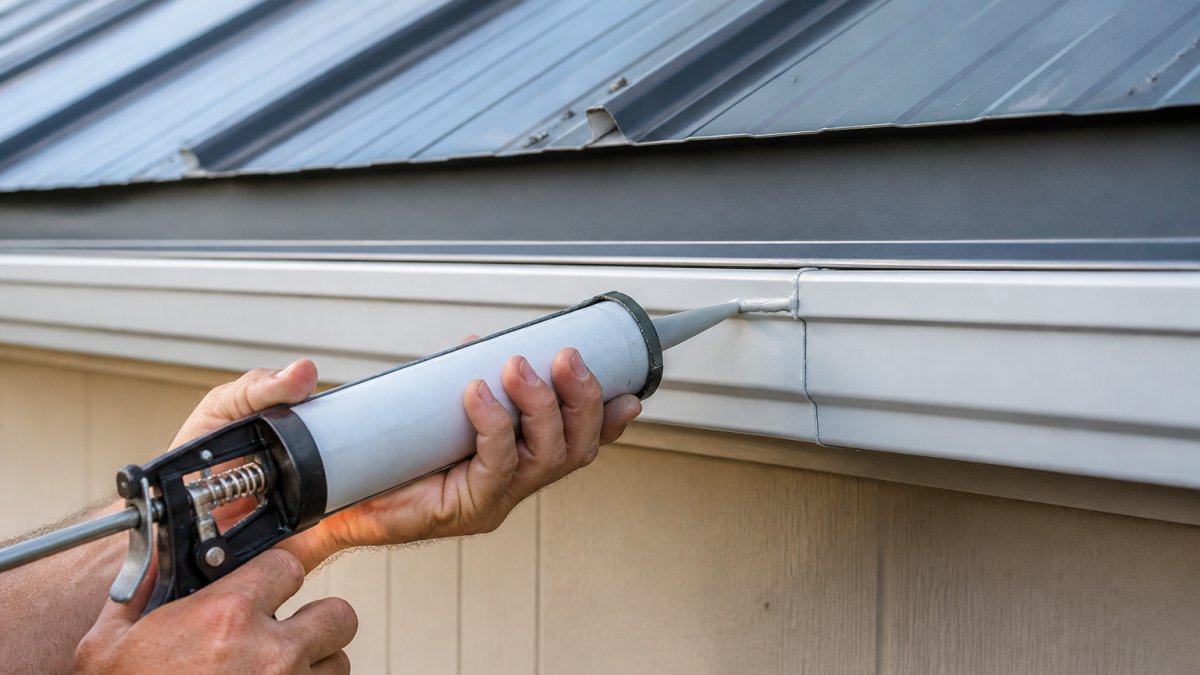
Load the caulking gun with a fresh cartridge. Cut the tip at a 45-degree angle to match the joint width.
Apply steady pressure at a consistent speed. Too fast leaves gaps; too slow wastes material. Aim for a continuous bead that fills the joint completely.
For wide seams (up to 1/4"), use a semi-self-leveling product and let gravity do the work; it flows in and settles flat without tooling.
For narrow seams, a standard tripolymer works well.
Don't overfill. A bead flush with the gutter surface is ideal; excess sealant is messy and doesn't improve performance.
Gutter Sealant Cure Time and Weather Resistance
Cure time determines when the joint is water-resistant and when it can handle full water exposure.
Most tripolymer sealants set within 24 hours and fully cure in 7-14 days.
Quality products resist rain and UV from day one, even before full cure.
Temperature affects cure speed: cold slows it, warm dry weather speeds it up. A sealant that cures in 7 days in summer might take 14 in winter.
Geocel 2320® Semi-Self-Leveling Roof Sealant →
Flexibility develops fully after cure: a freshly cured sealant is less flexible than an aged one.
Silicone Gutter Sealant vs. Tripolymer: Which Performs Better
This is where many contractors make a costly mistake. Silicone is cheap and familiar. Tripolymer costs more and is less common. But on metal, tripolymer wins consistently.
Silicone: Limitations on Metal
Silicone caulks are popular because they're cheap, easy to find, and work on wood, concrete, and tile. On metal gutters, they underperform.
Silicone needs clean, dry surfaces to bond, and metal gutters are rarely both.
Silicone also shrinks slightly as it cures, which can break the bond on metal, especially on imperfectly prepared surfaces.
Paintability is poor. Most silicones can't be painted, so your bead is visible. For aesthetic installations, this matters.
Silicone works on vinyl gutters or as a temporary metal patch, but for permanent metal gutter sealing it's a false economy.
Tripolymer: Why It Outperforms on Metal Gutters
Tripolymer chemistry was developed for roofing, where demands are extreme. It bonds to oily, damp, and even frozen surfaces, exactly the conditions metal gutters present.
Tripolymer stays permanently flexible and doesn't shrink, so the bond holds as metal expands and contracts. It resists UV better than silicone and maintains its properties for decades.
It's paintable to match gutter color and non-stringing for cleaner, faster application.
Most importantly, tripolymer is engineered for metal, tested on aluminum, steel, and copper specifically. That's intentional chemistry, not accident.
At ShopGeocel, we've engineered tripolymer formulas specifically for metal substrates. Products like Geocel 2300® Roof Tripolymer Sealant bond to damp and oily metal without primer, cure in real-world conditions, and stay flexible for years.

Common Mistakes That Lead to Gutter Sealant Failure
Most sealant failures aren't product failures, they're application failures. Here's what goes wrong.
Using the wrong sealant type. Applying silicone to metal gutters is the most common mistake.
Poor surface preparation. Rust, loose paint, and old sealant compromise adhesion.
Applying in wrong conditions. Sealant applied during rain or extreme cold doesn't cure properly.
Overfilling joints. Excess sealant wastes material and looks unprofessional.
Not waiting for cure. Running water before the sealant sets washes it out.
Resealing over failed sealant. If the old seal failed, new sealant over it will fail too.
When to Repair vs. Replace a Gutter
Not every leaking gutter needs replacement; a sealant repair can extend its life for years. The trick is knowing which leak you're looking at, because sealing a structurally failed gutter just delays the inevitable.
Read the Failure Before You Reach for the Gun
Seam and joint leaks. The classic repairable failure: two sections meet, the original sealant has aged out, and water weeps through.
End-cap leaks. Also repairable. End caps take heavy thermal stress and often fail before seams do. Same drill: strip, clean, reseal.
Fastener and hanger leaks. Repairable if the hanger is sound.
Pinholes and small punctures. Repairable if the surrounding metal is solid.
Longitudinal cracks along the gutter bottom. Usually a replacement signal.
Corrosion through the metal. Replacement.
The Decision Criteria That Actually Matter
Work through these in order. The first one that fails pushes you toward replacement.
- Is the metal sound around the leak? Probe it. If a screwdriver pushes through, the metal is gone. Replace.
- How many failure points are there? One or two isolated leaks are repair candidates; five or more across the run usually means end of life.
- Is the gutter still draining and sloped correctly? If water stands after a rain, the slope is wrong or the gutter sags. Sealant won't fix drainage; fix the slope or replace.
- How old is the gutter? A sound gutter under 20 years is worth repairing. Past 25, you're sealing one near the end of its service life, and the next leak is months away.
- Is the leak recurring? A seam sealed twice that still weeps means the joint moves too much for sealant to hold. That's mechanical, not an adhesion problem.
The Repair Economics
A sealant repair uses a cartridge and an afternoon. Replacement means new material, removal and disposal of the old run, new hangers, and labor across the full length, not just the failed section.
The math flips when failures multiply.
A useful rule of thumb: if a repair buys several more years on a sound gutter, it's good value. If it buys one season, you're renting time.
What a Good Repair Buys You
A properly executed sealant repair on a structurally sound gutter, correct product, clean substrate, right conditions, can add years of service. The sealant is the cheap part; prep and technique make it last. So the repair-vs-replace decision comes down to the gutter, not the sealant: if the metal is sound, seal it; if it's failing, no sealant will save it.
Frequently Asked Questions
What is the best sealant for metal gutters?
The best sealant for metal gutters is one formulated to bond to damp and oily metal surfaces while remaining permanently flexible. Tripolymer sealants outperform standard silicone on metal because they adhere without primer, resist UV and mildew, and move with thermal expansion without cracking. Look for products that meet ASTM C-920 standards and are specifically designed for roofing and gutter applications rather than all-purpose caulks.
Can silicone gutter sealant be used on metal gutters?
While silicone sealant can technically be applied to metal gutters, it has significant limitations. Silicone struggles to bond to oily or weathered metal surfaces without primer, and it often fails prematurely on exterior metal gutters exposed to thermal cycling and UV. Tripolymer formulas are engineered specifically for metal substrates and deliver superior adhesion, flexibility, and longevity on aluminum, steel, and galvanized gutters.
How long should gutter sealant cure before it gets wet?
Most solvent-based tripolymer sealants cure in 24-48 hours under normal conditions, but full cure can take 7-14 days depending on temperature and humidity. However, some formulas are engineered to cure underwater, allowing repairs on actively leaking or wet surfaces. Always check the product specifications for your specific sealant, rushing a repair before adequate cure time leads to washout and failure.
Do I need to prime metal gutters before applying sealant?
High-quality tripolymer sealants designed for metal gutters bond directly to clean, dry metal without primer. However, surface preparation is critical: remove dirt, algae, and oxidation with a wire brush or pressure wash, then allow the surface to dry completely. Primers can be used on heavily oxidized or painted surfaces for added assurance, but they are not required with properly formulated metal-specific sealants.