
How do you find a roof leak in the attic?
by Editorial Team
Last Updated: October 26, 2026
Quick Summary
To find roof leak attic issues, inspect the underside of the roof deck and rafters for water stains, dampness, and discoloration. Start at the highest point and work downward, paying special attention to roof penetrations, chimneys, vents, skylights, and flashing where water travels along framing before dripping.
- Water stains appear as brown, tan, dark, or gray streaks on roof sheathing and rafters
- Fresh stains feel damp and dark; older stains fade and feel dry
- Trace stains upward to find the source, as water travels along rafters before dripping
- Inspect roof penetrations, chimneys, vents, skylights, and flashing points first
- Distinguish roof leaks from condensation or plumbing leaks before selecting repairs
Table of Contents
- How to Check for Roof Leaks in Your Attic
- Signs of a Roof Leak in the Attic
- Inspecting the Roof Deck and Rafters
- How to Locate a Roof Leak in an Insulated Attic
- Distinguishing Roof Leaks from Other Moisture Sources
- Testing for Active Leaks with a Hose
- What to Do When You Find a Roof Leak
- Sealing Your Roof Leak Properly
- Frequently Asked Questions
How to Check for Roof Leaks in Your Attic
To find roof leak attic issues requires systematic inspection and the right approach. At ShopGeocel, the process starts with preparation and safety.
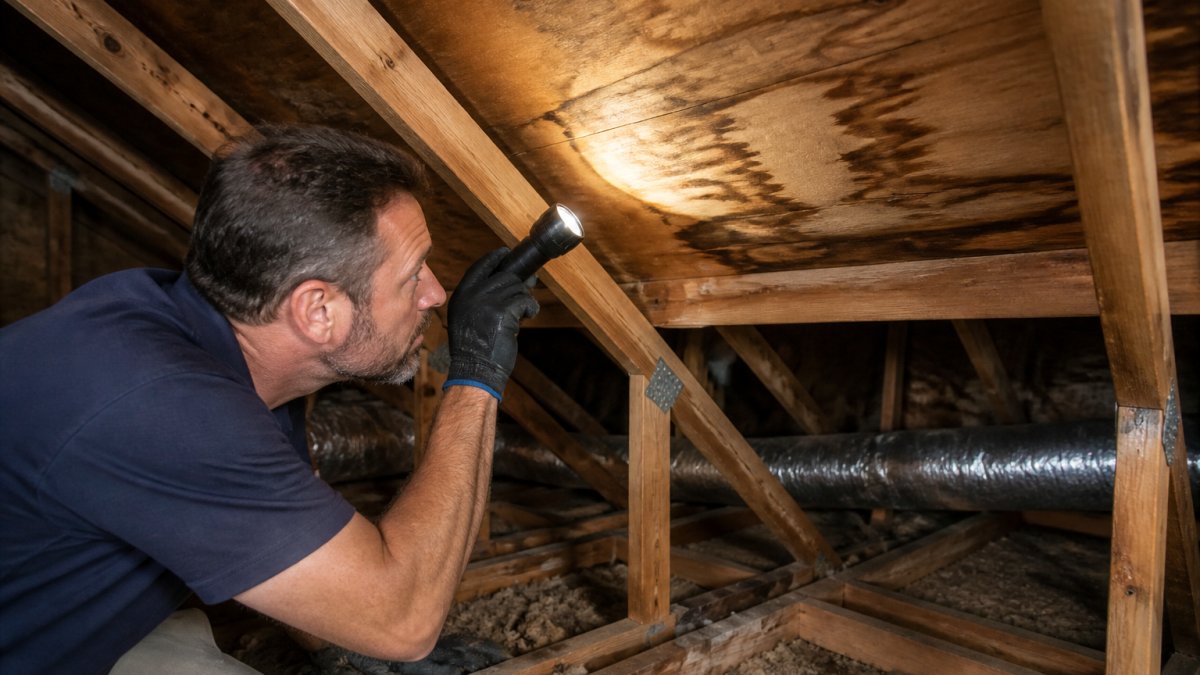
A roof leak in the attic may show itself through water stains, dampness, and discoloration on the underside of the roof deck and rafters.
Gather Your Safety Equipment and Tools
Attics are confined spaces with limited headroom, electrical hazards, and insulation that can irritate skin and lungs, so safety comes first (Synthetic Vitreous Fibers | ToxFAQs™).
Bring these essentials:
- Flashlight (headlamp preferred for hands-free inspection)
- Protective footwear with good grip
- Work gloves
- Dust mask or respirator
- Long sleeves and pants
- Sturdy ladder for safe access
Never rush an attic inspection. Move carefully across roof joists and rafters; stepping on ceiling drywall between joists can send you through into the room below.
Plan Your Inspection Route
Map out your inspection before climbing into the attic. Identify which roof areas are most exposed to weather and which have had previous water problems.
Start your inspection at the highest point of the attic and work downward. Water travels downslope, so tracing from top to bottom reveals the water's path more clearly. Pay special attention to roof penetrations, chimneys, vents, skylights, and flashing points where the roof meets vertical structures.
Document findings with photos or notes to track whether a leak is active or dormant and whether repairs are holding.
Signs of a Roof Leak in the Attic
Identifying physical evidence is the foundation of leak detection. Not all attic moisture means a roof leak, so knowing what to look for prevents false alarms.
Water Stains and Dark Discoloration
Water stains are the most visible sign of a roof leak in the attic. Look for brown, tan, or dark streaks on the underside of the roof deck and rafters. Fresh stains are darker and may feel damp; older ones fade and feel dry.
Discoloration often appears first on the roof sheathing. Trace the stain upward to find the source; it may be far from the actual hole because water travels along rafters and framing before dripping.
Damp and Damaged Wood
Run your hand along rafters and roof decking. Damp wood may show soft spots.
Mold and Mildew Growth
Mold and mildew may appear as black, green, or white spots on wood, insulation, and rafters.
Look for these physical indicators when inspecting your attic for roof leaks.
| Sign | Appearance | What It Means |
|---|---|---|
| Water stains | Brown, tan, dark, or gray streaks | Fresh stains are darker and damp; older ones fade and dry |
| Soft wood | Spongy or soft spots on rafters | Wood rot from prolonged moisture exposure |
| Mold and mildew | Black, green, or white spots | Growth in damp areas on wood, insulation, rafters |
| Wet insulation | Darkened, compressed, or clinging insulation | Water has soaked through and pooled in insulation |
| Nail pops | Fasteners pulled through roof deck | Structural stress from water damage and wood movement |
Inspecting the Roof Deck and Rafters
The roof deck and rafters may show evidence of a leak.
Examining the Underside of the Roof Deck
The roof deck, the wood sheathing directly under your roofing material, is one area to inspect. Use your flashlight to examine its underside.
Look for:
- Water stains in any color (brown, tan, gray, or black)
- Soft or spongy areas indicating wood rot
- Visible cracks or separation in the wood panels
- Nail pops or fasteners that have pulled through the deck
Checking Rafters for Water Damage
Rafters are the angled beams supporting the roof structure.
Inspect each rafter in the affected area:
Geocel RP-400® Wet-Dry Surface Roof Cement →
- Feel for dampness or soft spots
- Look for discoloration that stands out from the surrounding wood
- Check where rafters meet the roof deck, this junction is a common water collection point
- Examine the rafter's underside where water drips and pools
How to Locate a Roof Leak in an Insulated Attic
Insulation can complicate leak detection because it may hide water damage and trails.
Moving Insulation Carefully to Reveal Hidden Damage
Carefully pull back insulation to inspect the deck and rafters beneath.
Look for:
- Wet or damp insulation (it darkens when wet)
- Insulation that clings to wood or feels compressed
- Discolored patches where water has soaked through
Mark areas where you find evidence so you can return to them during repair work.
Tracing Water Paths Through Insulation
Pay attention to insulation saturation patterns. Wet insulation shows a clear trail where water has flowed. This trail points directly to the leak's location.
Distinguishing Roof Leaks from Other Moisture Sources
Not all attic moisture comes from roof leaks. Condensation and plumbing leaks can create similar-looking damage.
Roof Leaks vs. Condensation
Condensation requires improved attic ventilation and air sealing, not roof repair. Installing additional vents or soffit ventilation solves condensation problems.
Roof Leaks vs. Plumbing Leaks
Check for visible pipes near the stain. If pipes run above the damaged area, the leak likely originates there. Plumbing leaks require a plumber, not a roofer.
Testing for Active Leaks with a Hose
Once you've located the leak with a hose test, mark it clearly so repair work can begin immediately.
What to Do When You Find a Roof Leak
The next steps involve temporary mitigation, documentation, and selecting a repair sealant.
Temporary Mitigation and Documentation
Document the leak's location, the damage extent, and the date you discovered it.
How to Repair a Roof Leak: Step-by-Step Guide(page:1) provides detailed repair instructions once you've located the leak.
Selecting the Right Repair Sealant
Choosing the correct sealant determines whether your repair lasts or fails. Different roof types and leak conditions require different products.
For wet or damp attic conditions where you can't wait for surfaces to dry completely, asphalt-based roof cements that cure underwater are essential. These specialized formulas bond even when moisture is present, making them ideal for emergency repairs on active leaks. Applying these sealants provides a temporary reprieve, yet the underlying source often remains hidden elsewhere, necessitating a systematic approach to tracing traveling leaks before permanent damage occurs.
Geocel 2300 vs. 2320 vs. RP-400: Which Roof Sealant Fits Your Job?(page:2) compares sealant options for different repair scenarios. If your attic insulation is in place and you're working in damp conditions, you'll need a product engineered for those specific challenges.
Sealing Your Roof Leak Properly
For small-area repairs in damp attic conditions, the Geocel 2315LRF Leak Repair Fibered Brushable Coating works directly over damp wood. Its brushable formula applies easily in tight attic spaces, and the fibered composition handles small cracks and gaps that liquid sealants miss. At $24.34 per quart, it's a cost-effective solution for localized damage.
For larger leak areas or underwater conditions, such as active leaks on flat roofs or ponding water situations, Geocel RP-400® Wet-Dry Surface Roof Cement applies and cures even when surfaces are wet. Starting at $3.38 per cartridge, it's engineered specifically for the challenging conditions you face in attic leak repair. It remains soft and pliable through temperature swings, preventing the cracking that causes repairs to fail.
ShopGeocel offers sealants for roofing and leak repair. Start with inspection, document what you find, and choose a product suited to the listed application.
Frequently Asked Questions
How can I tell whether a stain in the attic is from a roof leak?
A stain in the attic may appear on the underside of roof decking or rafters. Check whether the stain is wet or damp to the touch.
How do I find a roof leak in an insulated attic?
In an attic, use a flashlight to inspect the roof deck and rafters. Document the location of any visible stains.
Why is the leak showing up far from where water enters the roof?
Water entering through a roof penetration or damaged shingle often travels along rafters, roof decking, or inside structural cavities before dripping into the attic. Wind-driven rain can push water sideways before it penetrates, and water may follow the path of least resistance downward, sometimes traveling 10 feet or more from the actual entry point. This is why tracing the water stain upward along the roof deck and following the grain of the wood is critical. The visible stain in the attic may be far from the leak source on the roof itself, making a systematic inspection essential.
What should I do after finding a roof leak in the attic?
Document the location with photos and measurements. Geocel 2315LRF is a brushable coating for small-area leak repairs and can be used in damp conditions. Geocel 4500 applies and cures underwater and withstands ponding water.
