
How to Fix a Leaking Roof: Best Emergency Repair Steps
by Editorial Team
Table of Contents
- Start With Safety: When to Stop and Call a Professional
- How to Find a Roof Leak: Tracing Water From Ceiling Stain to Roof Entry
- Temporary Roof Leak Repair: Emergency Steps to Stop Water Now
- Choosing the Right Roof Leak Repair Sealant for the Job
- Permanent Repairs: Matching the Fix to Your Roof Material
- How to Prevent Roof Leaks: Maintenance That Stops the Next One
- Repair Costs, Insurance, and When to Call a Roofer
- Conclusion: Fix the Leak, Then Fix the Cause
- Frequently Asked Questions
Last Updated: October 16, 2026
Start With Safety: When to Stop and Call a Professional
The best way to fix a leaking roof starts with knowing when not to climb. A leaking roof is an active water problem, and walking a wet roof in bad weather turns a small repair into a hospital visit.
Stop and call a professional if any of these are true:
- The roof pitch is steep or you need a harness to stay on it.
- The surface is wet, icy, or covered in moss.
- The leak sits near power lines, a chimney, or a skylight.
Water and electricity are a dangerous pair. The OSHA guidance on fall protection in construction is blunt about this: falls are the leading cause of death in construction, and roof work is where most of them happen.
How to Find a Roof Leak: Tracing Water From Ceiling Stain to Roof Entry
A roof leak rarely drips straight down. Water enters at one point, then travels along rafters, decking, and insulation before showing up on your ceiling, which is why the stain is often far from the hole.
To find the real leak source, work backward:
- Mark the drip. Note exactly where water lands inside.
- Trace uphill. Follow the ceiling stain, then check the attic above it.
- Look for water trails. Dark streaks, rust, or damp insulation point the way.
- Check the underside of the roof deck. Water stains on the sheathing show where it entered.
- Match the interior spot to the roof above. Go outside and look at the shingles, flashing, and vents in that zone.
A common mistake is sealing the ceiling stain and calling it done. That hides the symptom while water rots the decking and framing. The leak source is always on the roof, not the ceiling.
Temporary Roof Leak Repair: Emergency Steps to Stop Water Now
Temporary roof leak repair is about stopping water fast, then buying time for a permanent fix: block the water, protect the interior, stay safe.
Start inside. Move furniture, lay tarps, and put a bucket under the drip. If the ceiling bulges with trapped water, poke a small hole at the low point to drain it, a controlled drain beats a collapsed ceiling.
Tarping the Damaged Area
A tarp is the fastest way to cover a large breach. Use one that overhangs the damage by several feet on every side, and run it up and over the ridge so water sheds instead of pooling. Secure it with boards and rope, never nails through the shingles, and check it after every storm.
A few details separate a tarp that survives the week from one that flaps loose in the first gust:
- Run the tarp past the ridge. Water that gets under a tarp edge will find its way in; over-the-ridge coverage sheds on both sides.
- Do not nail through shingles. Every nail hole is a new leak. Use lumber laid flat across the tarp and rope or straps tied to a secure anchor.
- Keep the tarp taut. A loose tarp abrades shingles and tears apart in wind.
Patching Shingles, Flashing, and Vents
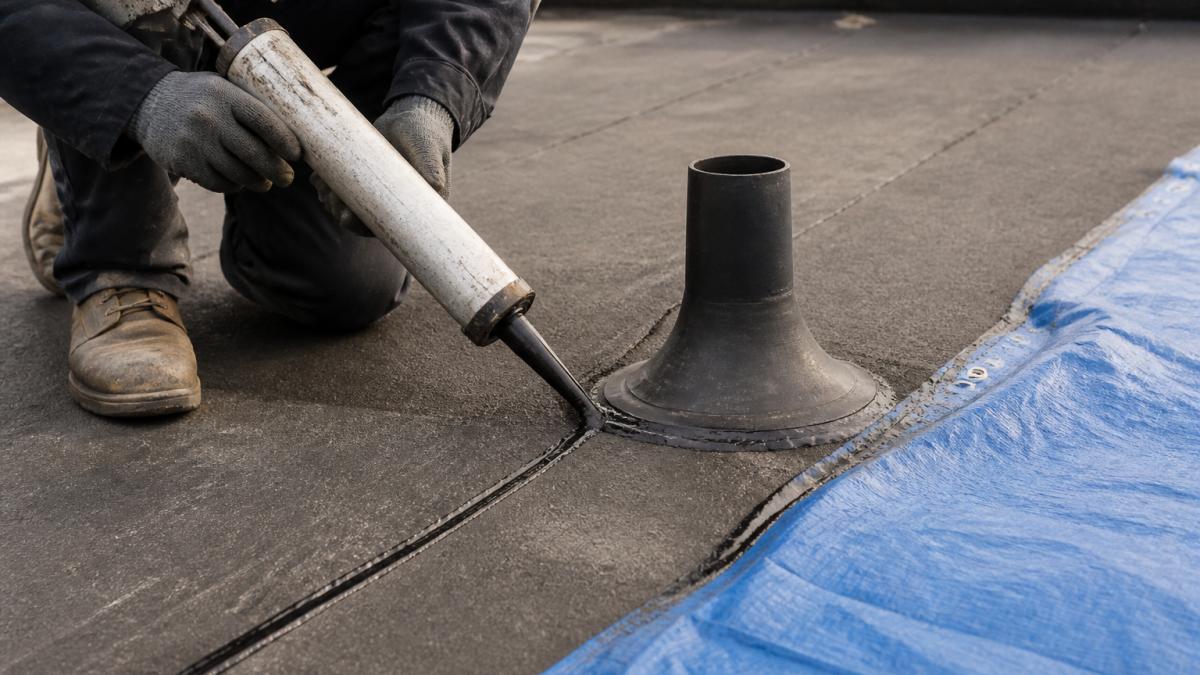
For a smaller leak, a patch works. Lift the damaged shingle, apply a bead of roof cement under it, and press it flat. For flashing and vent boots, clean the area and seal the joint directly.
Match the patch to the surface, because the wrong product fails fast:
- Asphalt shingles: Lift the shingle above the damage, apply roof cement underneath, and press the shingle back down. Add a second bead along the exposed edge.
- Metal panels: Clean the lap or penetration, then seal with a product rated for metal. Asphalt-based cement on bare metal can trap moisture and accelerate corrosion.
- Flat and membrane roofs: Use a sealant rated for the membrane. Many asphalt products are not compatible with single-ply membranes like EPDM or PVC and will not bond.
Our Geocel RP-400 Wet-Dry Surface Roof Cement is built for exactly this moment. It goes on wet or dry surfaces, even underwater, stays soft and pliable through temperature swings, seals fast, and will not pull apart.

What a Temporary Fix Will Not Do
A temporary patch stops water. It does not fix the cause. A tarp, a bead of cement, or a sealed vent boot buys days to weeks, a window for scheduling the real repair, not for calling the job done. Water that keeps reaching the decking rots framing, ruins insulation, and feeds mold. If the leak returns or the stain keeps growing, the entry point was never fixed.
Choosing the Right Roof Leak Repair Sealant for the Job
The right roof leak repair sealant depends on your roof material and the conditions. One all-purpose tube does not cover every job.
Here is how we match the product to the job:
| Roof Situation | Best Sealant | Why It Works |
|---|---|---|
| Flat roof, active leak, ponding water | Geocel 4500 Roof Bonding Sealant | Applies and cures underwater; bonds EPDM, TPO, PVC |
| Wet or dry asphalt, steel, brick, wood | Geocel RP-400 Roof Cement | Asphalt-based; seals wet, dry, or underwater |
| Flashing, trim, gutters, solar mounts | Geocel 2300 Roof Tripolymer Sealant | Bonds damp or oily surfaces; paintable; UV resistant |
| Gutter seams and narrow lap joints | Geocel 2320 Semi-Self-Leveling Sealant | Flows into seams and finishes flat without tooling |
| Metal roofing and siding, color matters | Geocel 4350 Hybrid Construction Sealant | 18 panel-matched colors; watertight down to 0°F |
| PVDF or SMP-coated steel panels | Geocel Phantom Metal Roof Sealant | Translucent bead blends into the panel color |
The 2300 is our flagship for a reason. It bonds to damp, oily, or frozen surfaces, resists UV and mildew, and applies without stringing for a clean gun-off.
For metal panels, color matching is the whole game. The 4350 comes in 18 colors and applies wet or dry down to 0°F.
Permanent Repairs: Matching the Fix to Your Roof Material
A permanent repair means fixing the cause, not just the symptom. A temporary patch stops water today. A permanent repair removes the failed part and rebuilds it so the leak does not return. The difference is not the product, it is whether the water's path into the roof is closed for good.
What that looks like changes with the roof. Here is the repair, material by material.
Asphalt Shingles
Shingle roofs fail at the same places: cracked or missing shingles, lifted nails, and dried-out flashing sealant. A permanent repair means replacing the failed shingle, not sealing over it.
Geocel RP-400® Wet-Dry Surface Roof Cement →
- Slide a flat bar under the damaged shingle and lift the nails.
- Remove the shingle and check the shingles above and below for damage.
- Slide the new shingle into place and nail it at the same points as the original.
- Seal the nail heads and the exposed edge with roof cement.
If the shingle above the damage is also cracked, replace it too. A new shingle tucked under a failing one will leak again at the first hard rain.
Metal Panels
Metal roofs leak at panel laps, ridge caps, and penetrations, not through the panel itself. Reseal the lap or penetration with a metal-rated sealant, and check the fasteners: a backed-out or rusted fastener is a leak path and needs a new gasketed screw, not a dab of sealant over the head.
For metal panels, color matching matters. A mismatched bead stripes the roof and looks like a repair from the street. A color-matched sealant lets the repair disappear into the panel.
Flat and Membrane Roofs
Flat roofs leak at seams, drains, and penetrations. A permanent repair means redoing the seam, not smearing sealant over it: clean the seam, apply the membrane's bonding adhesive or a compatible bonding sealant, and press it flat. If the membrane is punctured, patch it with the same membrane material and seal the edges.

Asphalt-based products do not bond to EPDM, TPO, or PVC. Using the wrong product here is a guaranteed callback.
Flashing and Vents
Flashing is where most roof leaks start. A permanent repair means replacing cracked caulking, reseating the flashing, and sealing the joint, in that order.
Vent boots are the same story. If the rubber collar is split, sealant will not fix it. The boot needs replacing. If the collar is intact but the sealant around its base is cracked, clean the joint and reseal it.
The Test: Patch or Permanent?
The difference between a patch and a permanent repair comes down to one question: did you fix the entry point, or just cover it? If water can still get under the edge, the leak is not fixed. A permanent repair closes the path. A patch covers it and waits for the next storm.
How to Prevent Roof Leaks: Maintenance That Stops the Next One
Most roof leaks start small and give you warning signs. A maintenance routine catches them before they reach your ceiling.
- Inspect the roof twice a year, in spring and fall.
- Clean gutters and downspouts so water drains away from the roof.
- Check flashing around chimneys, dormers, and vents for cracks.
The thing nobody tells you about roof maintenance is that it is mostly about water flow. Keep water moving off the roof and away from the house, and most leaks never start. For metal roofs, a color-matched sealant like our Geocel 4350 Hybrid Construction Sealant lets you reseal trim and flashing without a visible scar.

Repair Costs, Insurance, and When to Call a Roofer
A small DIY patch costs very little. A full professional repair costs more, and the price swings with roof size, pitch, material, and how much damage water caused underneath. We do not quote installation or labor rates, because those depend on your local market and the scope of the job.
What we can tell you is how to protect yourself on the paperwork:
- Document everything. Photograph the leak, the ceiling stain, and the roof damage before and after any repair.
- Keep your receipts. Save the sealant, tarp, and any contractor invoices.
- Check your policy. Many homeowners policies cover sudden water damage but not long-term neglect. Read the exclusions before you file.
The FEMA guidance on documenting disaster damage makes the same point for storm claims: clear photos and records speed up the process and support your claim.
Conclusion: Fix the Leak, Then Fix the Cause
Stopping the water is step one.
That is where ShopGeocel comes in. For over 50 years, we have made professional-grade sealants built for specific substrates rather than one-size-fits-all tubes. Our formulas stay flexible for years, cure underwater for active leaks, and come in color-matched options for metal roofing and siding.
Get started with ShopGeocel and stop the next leak before it reaches your ceiling.
Frequently Asked Questions
How do you fix a leaking roof without replacing it?
Most leaks do not require a full replacement. Trace the leak source, then repair the specific failure: reseal cracked flashing, replace missing or damaged shingles, or patch the seam with a roof leak repair sealant. Products like Geocel 2300 bond to damp surfaces and stay flexible, so the repair moves with the roof. Replace the roof only when the decking or underlayment is saturated or the shingles are at the end of their service life.
How do you stop a leaking roof during heavy rain?
You can stop active water during rain with a sealant that applies and cures underwater. Geocel 4500 is built for exactly this: it bonds EPDM, TPO, and PVC membranes and withstands ponding water, which makes it the standard for night seals and can't-wait repairs. For asphalt surfaces, RP-400 Wet-Dry Surface Roof Cement works on wet or dry roofs and even underwater. Do not climb a wet roof; work from a stable position or wait for a break in the weather.
How much does it typically cost to repair a roof leak?
Cost depends on the repair type and roof material. A tube of sealant for a DIY patch costs a few dollars: Geocel RP-400 starts at $4.62, Geocel 2320 at $7.50, Geocel 2300 at $9.10, Geocel 4350 at $10.99, Geocel 4500 at $13.99, and Phantom at $15.99. Professional repairs vary widely by damage and region, so get a written estimate before work begins and document the damage for insurance.
Will a roof sealant stop a leaking roof?
A sealant stops a leak when it matches the substrate and the damage type. Geocel 2300 handles flashing, trim, and gutters on most roofing surfaces. Geocel 4500 seals flat-roof membranes like EPDM, TPO, and PVC, even underwater. Geocel 4350 and Phantom are engineered for metal panels, with Phantom's translucent bead blending into PVDF and SMP-coated steel. Sealant will not fix a failed deck or a large opening; those need a permanent repair.